OPTIONS

Thursday, September 23, 2010

THREE BLACK CROWS - Bearish Candlestick Pattern


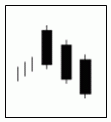
Three Black Crows (Bearish)

Three Black Crows is a top reversal / bearish reversal formation.
It could occur at the end of an uptrend, or during a bounce within a downtrend, or at the resistance.

This pattern consists of 3 consecutive long black candlesticks that appear in an upward price trend.
The opening price of Candles 2 and 3 of the pattern should be higher than the previous day's closing price (i.e. The prices open within the previous day’s body).
And all the 3 candles should close near or at their lows, and make new lows in each day.

Since all the 3 candles should close near or at their lows, the lower shadows of the Three Black Crows formation are normally short, or even no shadow in some cases.

This pattern is formed when the prices are in overbought condition, and indicate a sign that the bulls might have lack of conviction in the current uptrend. This uptrend has now reached levels where the bears have started to short the market.
On 1st day, due to increasing selling pressure, the price closes below its opening price.
On 2nd and 3rd days, it seems that as if the price wants to regain its former strength, as the price opens higher than the previous day’s close. However, by the end of each day, the sellers would regain control, causing the price to fall to a new closing low (i.e. the price closes at lower levels than previous day’s closing price).

The Three Black Crows pattern does not occur very frequently. However, when it does occur, traders / investors should be very alert, because their appearance indicates a period of strong selling pressure, and hence the reliability of this pattern is likely to be very high. If on the 4th day the stock is not able to show strength, then lower prices may potentially continue.

The reliability of this pattern tends to increase in the following conditions:
1) Longer black candlesticks’ body.
However, it should not be too long as well because if the black candlesticks are too long (over-extended), traders / investors would worry that the market could be oversold by now and hence may pause accordingly.
2) Shorter lower shadow of the candles.
3) The opening prices of the 2nd and 3rd days can be anywhere within the previous day's body. However, it is better to see the opening prices to be below the middle of the previous day's body.
4) Increase in trading volume.

Although the reliability of this pattern is likely to be very high, but it is always better to substantiate this signal with other technical indicators to confirm that the momentum is actually changing.

Analysis Tool:
Get Free Trend Analysis for your favorite symbols

Other Learning Resources:
* FREE Trading Educational Videos with Special Feature
* FREE Trading Educational Videos from Trading Experts

Related Posts:
* Learning Candlestick Charts
* Learning Charts Patterns
* Options Trading Basic – Part 1
* Options Trading Basic – Part 2
* Understanding Implied Volatility (IV)
* Option Greeks

Wednesday, September 8, 2010

One-Cancels-Other (OCO) & One-Cancels-All (OCA) Orders

One-Cancels-Other (OCO) Order is a group of orders that consists of two individual orders; if one of the orders is executed, then the other order will be automatically canceled.

One-Cancels-All (OCA) Order is a group of orders that consists of 2 or 3 individual orders. When any one of the orders in the group fulfils a trigger condition, the triggered order will be sent to the market for execution, whereas the other order(s) will be automatically canceled.
Basically, One-Cancels-Other (OCO) Order and One-Cancels-All (OCA) Order are similar. The difference may be that OCO Order consists of two individual orders in a group, while OCA Order can be made up of 2 or more individual orders in a group.

Generally, the following are some characteristics of One-Cancels-All (OCA) Order:
* Individual orders in one OCA group order can be either stocks or options, and the security type does not need to be consistent across all individual orders in the group. That means you can mix the orders for stocks or options in one OCA group order.
* Once one of order is triggered, the other remaining order(s) in the group will be canceled. The triggered order does not need to be executed for other remaining order(s) to be canceled.
* All orders in an OCA group order will be are held at the brokerage until triggered. Once triggered, the triggered order will be sent to the market as either Market Order or Limit Order as set by the trader/investor.
* If one order is partially filled, the remaining order(s) will be reduced proportionately to the remaining quantity of the unfilled order.
* If one order is canceled by the trader/investor before it gets triggered & executed, all the remaining order(s) will automatically be canceled as well.
* However, if one of the orders is rejected or canceled by the system, the remaining order(s) will NOT be canceled automatically.

Some examples of how you can make use of OCA order:

Example 1:
You want to enter into a long position in either a particular stock or an option in that stock.
You can place a One-Cancels-All (OCA) order that consists of the following orders:
a) Order 1 – Buy stock DEF with Limit Price of $30.00.
At the time you’re placing the order, stock DEF is trading at $32 / share.
b) Order 2 – Buy option DEFJKL of stock DEF with Limit Price of $1.60.
At the time you’re placing the order, Option DEFJKL is trading at $1.80 / contract.

If the price of stock DEF drops to $30.00 before option DEFJKL hits $1.60, Order 1 will be triggered and sent to the market as Buy Limit Order to buy stock DEF at $30.00 or lower. At the same time, Order 2 will be canceled automatically.
On the other hand, if the price of option DEFJKL drops to $1.60 before stock DEF hits $30, Order 2 will be triggered and sent to the market as Buy Limit Order to buy option DEFJKL at $1.60 or lower. At the same time, Order 1 will be canceled automatically.

Example 2:
You’ve own stock OPQ that is currently trading at $25.00. In order to manage the position without having to constantly monitor the market, you want to place Sell Limit Order at $32.00 to lock in profit when the price has reached your Profit Target Price, and Sell Stop Order at $20.00 to limit your losses in case the price moves against your expected direction. When one of the orders is triggered & executed and your position is closed as a result, the other order will be automatically canceled.
Note:
The purpose of the order in this example is actually similar to that of Bracketed Order, which is to allow you lock in profit and limit your losses.
The difference is that in this case, you place the above two opposite orders when you’ve already own the stock; whereas for a Bracketed Order, the above two opposite orders are submitted together with the buy order for opening the position.

Disclaimer:
This order is a more complicated order, not all brokerages can accept this order.
Even the procedures, rules, terms and/or how to place this order may vary from one to another brokerage. Hence, you need to check with your own brokers specifically for the details before placing such order.

For the list of other types of order, go to: Types of Orders in Trading.

Related Topics:
* Free Trading Educational Video: Learn Technical Tips from Dan Gramza
* Option Greek
* Understanding Implied Volatility (IV)
* Understanding Option’s Time Value
* Learning Candlestick Charts
* Learning Charts Patterns

Friday, August 27, 2010

FALLING WEDGE PATTERN – Part 2: Important Characteristics

Go back to Part 1: Falling Wedge Formation

Important Characteristics of Falling Wedge Pattern

Existing Trend:
There should be an established existing trend (either uptrend or downtrend). As mentioned before, Falling Wedge, which has a bullish bias, can be categorised as a reversal or continuation pattern.
As a reversal pattern, Falling Wedge normally occurs after an established downtrend. The slope of Falling Wedge will be downward, which is in the same direction as the prevailing trend.
As a continuation pattern, Falling Wedge occurs after following an uptrend. The slope of Falling Wedge will still be downward, but this slope will be against the prevailing uptrend.

Shape of Falling Wedge:
* There should be at least 4 reversal points to draw two converging lines, i.e. two successively lower peaks (highs) forming a downward sloping upper line and two successively lower troughs (lows) forming a downward sloping lower line. The descending upper line acts as resistance, while the descending lower line as support.
The more times the price tests each level, particularly on the upper side (resistance), the higher quality the wedge pattern is thought to be.
* The upper line (resistance) should have a sharper slope (more negative slope) than the lower line (support). If the lines were extended to the right, both lines would converge and slanted in a downward direction.
* There should be some distance between the two peaks as well as the two troughs.
In other words, prices should increase and hit the descending upper line then decline for at least twice (forming at least two peaks). Prices should drop and hit the descending lower line then bounce up for at least twice (forming at least two troughs).

Volume:
Volume should be diminishing; heavy at the beginning and contracts as the pattern develops.
However, when breakout occurs, there should be a significant increase in volume.
Monitoring the existence of significantly higher volume to confirm a valid breakout for Falling Wedge is more crucial than for Rising Wedge.
Without a significant surge in volume, the upward breakout above the resistance of Falling Wedge would lack conviction and be more vulnerable to failure.

Duration:
This pattern is generally a longer term pattern. It takes from about 3 to 6 months to form.
If the pattern duration is less than 3 weeks, it can be considered as a pennant.

Breakout Direction:
For Falling Wedge, the breakout usually happens to the upside, hence it is considered as a bullish pattern. However, the breakout might also occur to the downside.

Breakout Confirmation:
Sometimes, the price may also make a deceptive/invalid breakout whereby it touches above the upper (resistance), but then it moves back down again & resumes downtrend.
One possible way to prevent this is by having certain criteria to confirm if the breakout is a valid one.
A minimum penetration criteria for a breakout should be the price closes ABOVE the upper (resistance) line, not just an intraday penetration.
Some traders may apply certain price criteria (e.g. 3% - 5% break from the upper (resistance) line depending on the stock’s volatility) or time criteria (e.g. the breakout is sustained for 3 days) to confirm the validity of the breakout.

Potential Price Target:
For Wedge pattern, there is no price target, as it is difficult to project specific potential price target in this pattern.

Return to Breakout Level:
After the breakout occurs, the price may sometimes return to the breakout level for an immediate test of this new resistance before continuing their moves in the direction of the breakout. (Remember that the support now has turned into new resistance level).
However, the prices should not re-enter the wedge and move outside the opposite line of the breakout line. When this happens, it means the pattern has failed or considered in invalid.

To find out more about other Chart Patterns, please refer to:
Learning Charts Patterns

Analysis Tool:
Get Free Trend Analysis for your favorite symbols

Other Learning Resources:
* FREE Trading Educational Videos with Special Feature
Free Trading Videos:
* FREE Trading Educational Videos from Trading Experts

Related Topics:
* Learning Candlestick Charts
* Options Trading Basic – Part 1
* Options Trading Basic – Part 2
* Understanding Option Greek
* Understanding Implied Volatility (IV)
* Understanding Option’s Time Value